27th April- 30th May 2025 at Juneja Art Gallery, Jaipur 148th Show by Artchill
Human body is a vehicle for the traveling spirit.
As the language of contemporary art continuous to evolve, these bold & Brilliant artists explore deeply & offer fresh perspectives on environment, their memories and the rapid transformations in our social fabric. Each stroke is witness to the quiet meditation & dialogue between the artists and the varied media they handle. Each miraculous layer reveals their explorations and deep resonance. Many artists recoil from the increasing materialism in our society as it is replete with disguise and masks. Using their miraculous energy forces & elements of figuration or playful distortion, then simplification- to create their alternate mystical realms articulating their personal vision and concepts, they create amazing narratives through their quasi figurative and abstract visual language.
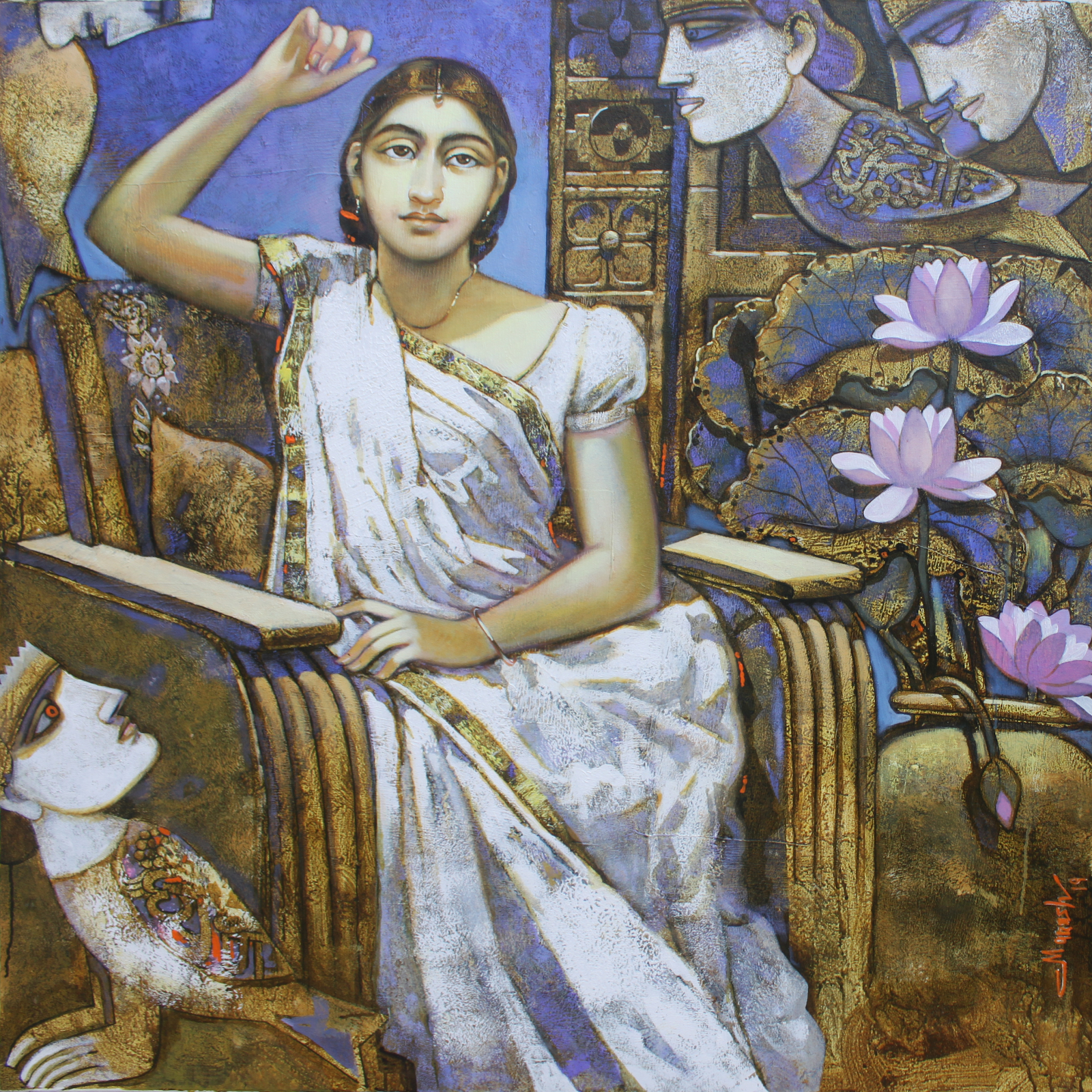
Some artists like Vijender Sharma, Asit Patnaik, Manash Jena, Khetanchi in this show are expressing remarkable serenity & a stricking evidence of strength & skill in organizing forms, colors & textures to create the effect of enchantment and fantasy. Artworks by Suparna Mondal, Shabana Qadri, Nitasha Jaini show incredible richness & extravagance. Special art by Ashish Shringi, Ganga Singh, Surjit Akre, Sajid Bin Amar, Anjani Reddy & Deepak Khandelwal carry the fragrance of nativity. Artchill is showcasing a very promising artist Shehnaz Mansuri for first time.
Outstanding works of art in this show are by PN Choyal ,Yusuf, Jai Zharotia, Shahid Parwez, K S Radhakrishnan, Nayanaa Kanodia , Surjit Choyal.
These awesome artworks in ‘Theatrical Assimilations’ give us a Holistic & multisensory, rich & engaging Art Experience.
At the heart of Laxman Aelay's bold artistic display lies a singular theme: the radiant figure of Poolamma, beloved mother of flowers, revered in festive tradition by Dalit communities throughout Telangana. With deft skill and a masterful eye, the artist weaves together the tapestry of identity, blending familiar design patterns with hidden layers of meaning. The intricate textiles, though mere copies of the original, find a home within the attire themselves, a testament to the artist's deep connection with the weaving community. But what truly sets this work apart is its empowering depiction of Telangana women. No longer portrayed as impoverished and defeated, they now stand strong and beautiful, their heads held high in triumph over destiny. These women are the victorious mothers of a new era, their material existence a testament to their resilience and hope. In the midst of a free and blooming Telangana, they reclaim their spaces with a fierce and feminine spirit, embodying the very essence of nature's life-giving power
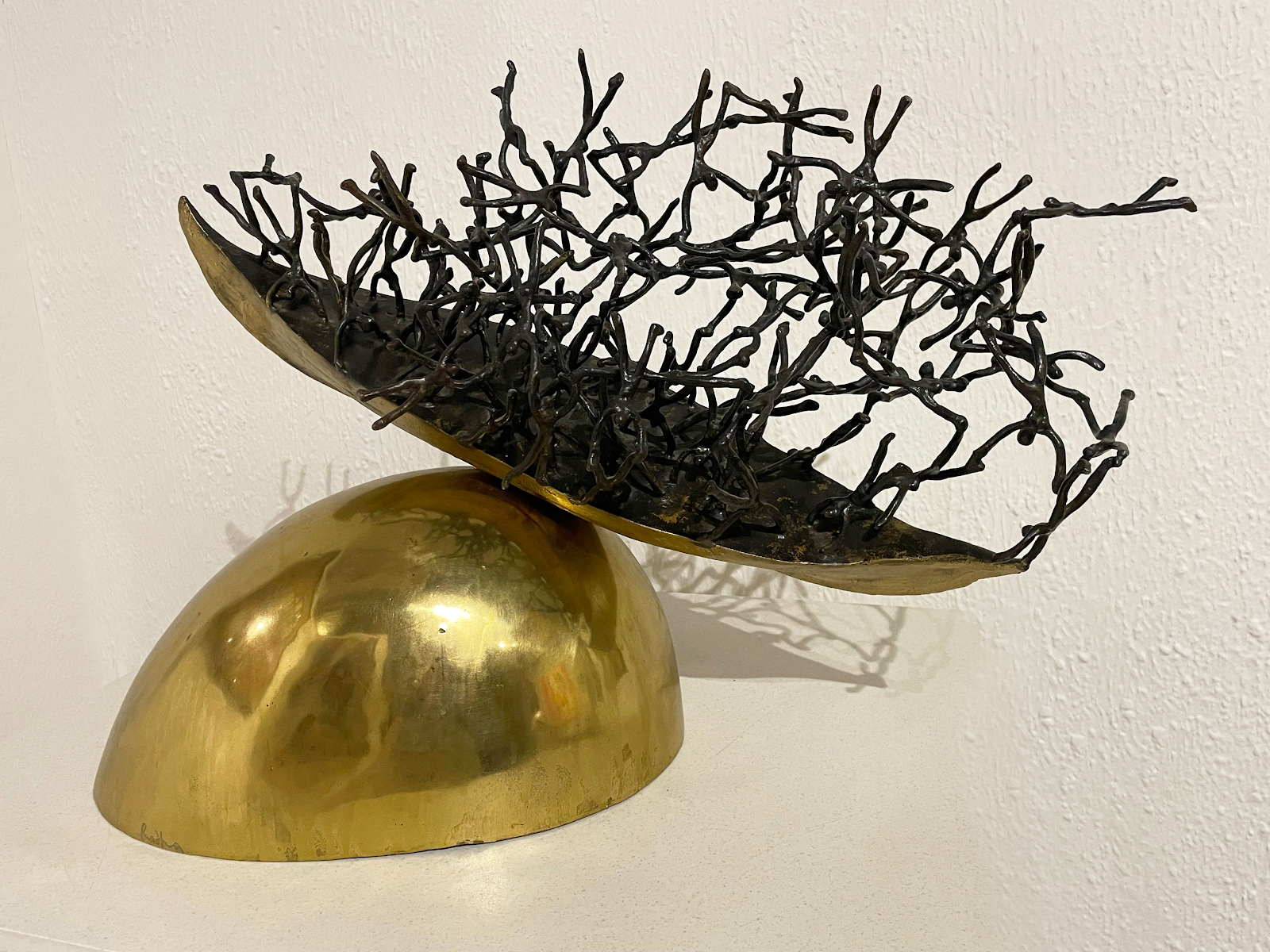
Born in Kerala in 1956 and trained in sculpture at Santiniketan, K. S. Radhakrishnan belongs to a small group of notable sculptors of his generation who have collectively brought about a far-reaching resurgence in Modern Indian sculpture.
The body is a marker of our individuality and our shared humanity, but our political and social realities fracture our collective humanness at many levels. Radhakrishnan engages with this conundrum of our existence through explorations of collectiveness using the human figures- a series of small sculptures in which an infinite number of tiny figures are brought together to form shape-shifting murmuration-like human formations.
He offers these sculptural meditations not as ponderous statements but as subtle experiences- Fragmentation, repetition, and grafting define his work process. Most of his large figures, invoking the singular and almost all the smaller ones denoting the de individualized multitudes, are done by welding multiple fragments together. He is suggesting, as it were, that our sense of wholeness and singularity of form and movement is an illusion born out of parts fused together.
I have a firm belief that universe mystery cannot be solved. Whenever I tried to solve it, I became part of it. I became stranger to myself and witness a singularity that evoked through my artistry and imagination to create a vivid impression of reality. This is my world as images rise and fall as I breathe. They are not bound by physical reality, they are free to move wherever they desire; they dance up and down, here and there, dissolve into each other and sometimes even disappear. My consciousness summons the images, provokes them and gives rise to my own parallel universe. I may be painting a bird, trees, animals, books, mountains or a clown, women; anything, all become part of one. They are all same to me, no disparity, no discrimination, no caste or creed. I fly with the birds and fall down with a leaf from the tree. I get mixed with the water and flow with it. As I paint everything comes out from nothing and returns to nothing. I am just evoking my eternal space where images rise, evolve, arouse and then liquefy into another space.
The eternal movement of the cosmic world awakes mysteries and riddles which always baffle me; and sometimes haunt me too. They whisper in my ears and convince me of intrinsic unity of the cosmic events.
My work brings urban man’s story on the table the sequencing of images is only through the male form. I have produced one work after another, exploring the urban man as my subject. Women as muse has been used in art both by women and men artist. However my interest lies in exploring the male of the species.
The layering of emotions in urban relations, the swings and pulls pushes of volatile human temperament gets reflected in my work, the city remains in focus, the buildings are omnipresent in my works. The laser cut-outs become the enclosed space for the dialogue. The laser cut-outs retain their machine preciseness, whereas the painted surfaces are human, imperfect, stamped, distorted and layered. Pencil, brush rollers all my instruments.. Photography of staged models is the starting point of my paintings.
He has carved a niche for himself not just as a figurative artist of the feminine figure, but as a “Figurative Feminist.” His canvases bring a wide range of women-related social and emotional issues to the forefront of our male-dominated world, reflecting the dichotomy of our society like a mirror. Jena’s work highlights the contrast where women are both idolised as ‘Devi’ or Goddess and yet not accorded their due respect.
Moumita's art is an unrolling canvas of life, where in are charted, celebrated & endured : the joys, pains, sorrows, agonies & aspirations, which may come in the course of day to day living. The sheer range of her work is enchanting & invigorating. The way she explores & handles the delicate themes & contours of emotions, is a treat to watch. If one of her work is zestful, joyous or pulsating with life, the other is subdued, pensive & conveys sorrow or suffering. The immediacy & urgency of her work, emotively carves out an ideogram in a thoughtful manner.
She uses her lines & colors in a free lowing manner, to uphold, to toss, to jostle, to swing & to move the figures & faces, in the airiness of the space, or plants them firmly on the ground, to the wondrous effect. The beholder's eye participates in her 'playful act' of communicating or suggesting something significant. Her oeuvre is not only varied, but also large and the quantity is not without soulful outpouring. Prayag Shukla
20th Oct - 12th Nov 2024 at Juneja Art Gallery, Jaipur
147th Show by Artchill
Yusuf's creations are an intricate dance of sensory and emotional depth, seamlessly blending perceptions and realities with a metaphysical openness that invites endless exploration. Each piece is a unique voyage, traversing the landscapes of memories and sensuous experiences, all while maintaining a remarkable 'lightness of being'. This lightness belies the substantial 'load' of life that his works carry.
The serene and buoyant atmosphere, rendered through subtle gray tones and vibrant colors, invites viewers into a tranquil yet dynamic world. Yusuf's lines flow effortlessly like veins through rock, yet they can twist, break, and splinter, imbuing his works with a poignant and captivating quality. These lines often rise and fall in gentle undulations, coalescing into amorphous forms teeming with life, inviting contemplation on the essence of existence.
The curves, crevices, and cavernous depths of Yusuf's lines invite a deep reflection on the nature of being. Even the broken lines and bold patches of color engage in a profound dialogue, creating a narrative that is both sublime and compelling. His works possess a mellifluous quality, drawing viewers into a magnetic sphere rich with intent and substance.
Renowned painter and art thinker J. Swaminathan once observed of Yusuf's lines:
"These drawings are self-contained entities of their own. They reveal a world of meaning to us not contained in our lexicon. Yet, our senses apprehend them. We are able to sense them without being able to pigeonhole them. Herein lies the magic of the drawings of Yusuf."
This magic extends to his paintings as well, which could make them an essential part of any artistic discourse.
The Ethereal Elegance of Yusuf’s Sculptures
'Kalpvraksh'
In Yusuf's oeuvre, his uniquely crafted sculptures too stand out. These pieces, suggestive of the relationship between man and machine, eloquently address the modern human predicament—how to live with machines. Almost in a state of flight, the sculptures possess a certain grace, and their presence is enchanting. They remind us of how we are bound to live with machines, providing comfort yet also causing discomfort. At times, we wish to free ourselves from their clutches, yet we remain tethered. One might also recall the superb film by Charlie Chaplin, Modern Times, which explores a similar dilemma. But let’s return to where it all began for Yusuf.
One day, Yusuf saw a photograph in a newspaper of a man carrying a sewing machine on his shoulder, waddling through rising floodwaters, trying to save the machine. In the photograph, the man's head and the machine’s head appeared almost fused together.
'Yakshini-2'
Yusuf was moved by this portrayal—a man and his machine united in a single moment. Coming from a family of master tailors, he was naturally drawn to the scene, having been familiar with sewing machines since childhood. Later, he learnt that the photograph was taken by photographer Steve McCurry as part of his monsoon series from India and abroad. The photograph fired Yusuf's imagination, and the result was a series of sculptures done with various materials. The series continues with ever-changing, appealing imagery, consisting of faces both ordinary and divine, with many components from nature.
One of the figures, with a predominant blue shade, exudes a distinct charm. The ornate, bead-studded headpiece, earrings and wings convey a certain regal and divine essence. Interestingly, the machine here does not have a dreary and dull presence. Rather, the relationship shown is symbiotic, almost idyllic, evoking a sense of abundance, power and a certain shimmering sacred splendor. The face has a rather calm and introspective expression, unfolding its wings in a sort of spiritual ascent, with the radiance of a deity but with the framework of a device.
'Devi'
The textural feel of the sculptures is powerfully executed. As with his paintings, the painstakingly intricate details of the sculptures are crafted with love and care, offering a seminal visual delight. The subtlety with which the man’s desire to see beauty in machines is conveyed is astonishing.
Whether we choose a flight from the machine or a flight with it, we find ourselves on the brink of transformation. In whatever way we look at these amazingly done “bodies,” we tend to appreciate them for their elegance, charm, and integrity which leave us with a sense of awe and admiration.
When a point moves, a line is drawn. In my art the line plays a very important role. When I picturise the group of lines as a basic element, a strange happening occurs. Many lines emanate from this indivisible point, which then give birth to innumerable unrecorded lines. So, when I draw one single line I am actually creating two of them – positive and negative. The white lines between two drawn black lines is not purely space that has been left out. It is actually a deliberate effort. They also form to my line drawings, the same way as the black lines do. The two combine to produce a sensuousness which breathes life into my lines and gives them dynamism and mobility.
'The Served Man'
For me the line is a living unit, full of limitless possibilities I believe that when an artist creates a shape using the line, then it is the line that gives it a definite shape, then ending all other possibilities. That is why in my line drawings you do not see shape of any natural thing – my group of lines is full of possibilities capable of being taken anywhere. My creations are not created through extraneous lines. Infact they are a group of innumerable lines which can be increased or drawn in any direction. And so my line drawings have their origins from the lines, their space and form is always basic where the innermost values remain the same and where the possibilities are endless.
Abstract art is not an imitation of reality or a parallel depiction of it, but it does have a relation with the reality which is often complex and dialectical in its nature. In abstract art, realism gets transformed into what can be called a ‘higher or heightened realism’. Contemporary artists are now open to experimentation on new ways of visualization , to liberate oneself to the spirit of experimentation.
In this current show titled ‘ALCHEMY- Realm of Tonality & Textures’ each artist opens a window of their creative realms with controlled drawing of lines , use of varied colour tones and of interesting mixed media. These bubbles are waiting to burst with their spirit of energies to celebrate the ease, the play of colours, tones, lines and forms; colors represent fascinating variations, layers and hazes of light and create a pervasive veil of atmosphere. Integrally linked the works then operate in a lattice of interfaces between belonging and being, open to influences both local and global, the skill of training and the color of contemporaneity. This Leitmotif of the textural idioms arouses an unbridled pleasure; it leads, invariably, to an addictive idiom of continuous stimulation-by-image, a loss of correspondence between real-world imperatives and inner world fantasies.
This current show at Juneja Art Gallery, surveys a body of work that leaves itself incisively open, somewhere between being created and wholly complete. Their paintings, may not be muted in color or form, but they are bold and powerful and carry a story to narrate. The textures that they add to each canvas echo the trials and tribulations of observations they all ponder over in the everyday idiom of lifestyles and living. Nature offers them pictorial and aesthetic beauty and inspires them with images and ideas. These artists never loose focus as they glide over their energy forces, deftly using elements of abstraction, distortion and simplification to create an alternative world on canvass.
Each of these artists create intimate glimpses of uncanny worlds and mindscapes suffused with an atmosphere of the unknown . Processes and the possibility of instability, openness, and perpetual transformation underlie the creation and understanding of all the exhibited works.
Amit Kalla : ‘Painting is a thoughtful and humble commencement for me to understand the crux of visual artistic journey along with the considerate subject which moves in between the language of form and formlessness. In my works there is an effort to create impact in a whole and enriching way, through transitional engagement in the painting, which leads the whole process to a higher level of consciousness where time, space and environment have an impetus role which is undoubtedly realized. Much of the imagery comes from my unconscious; There is a profound impact of formalist ideas and thought too on my process, ample activity can be observed on the canvas, at the same time there is presence of settled emotions too. There is some kind of quest, rethinking a remapping’.
Anil Mohanpuriya : His canvasses are modernist in nature with impressionistic undertones. His skill is evident in the way he creates imaginative and stunning cityscapes as molten images in various hues .
Dharmendra Rathore a well known artist, depicts remarkable states of serenity in his paper works , a striking evidence of great strength and skill in organizing forms and colours and creating the effect of enchantment and fantasy. To create vitality & dynamism in an animate mass is a difficult proposition. It takes courage and tenacity as artists explore an addictive idiom , reflecting in some ways the conditions of artistic practices within the broader domain of expressive culture.
Khetanchi : For him Painting is a practice of searching the relevant meaning of nature’s sign, it’s a kind of pure meditative search, in which he deeply found himself submerged and wrapped up, in the variety of different moods, tones and textures in a method which derives through seeing and conjures up colors so thoroughly, each breath becomes stroke of Painting. There is intense and immeasurable imaginative appearance in his abstractions which are outstanding and acquitted, all the way through art works he proved himself as a true explorer of void, as like someone who constantly exploring the real denotations and metaphors of distinctive visual language and trying to manifest the higher realm of aesthetic experience. Gazing his works one can clearly assume his dedication towards subtle symbolic understanding of both form and formlessness.
Nupur Kundu a well known Indian artist, experiments in a wide palette of colour and enjoys impasto oils on her canvases .The palette knife work, the thick impasto paint – it all makes some of the works of these series almost sculptural ! She says “I endeavor to embody in my work the ineffable in colours. The colors are given freedom to flow, move, and dialogue with each other, share inaudibly and even invisibly the mystery of their being. They carry no thematic burden nor are pushed into the straight jacket of meanings. They are a narrative into themselves primarily ‘Colourscapes’ . Nupur renders nature as well as emotive moods through organic motifs, geometrical forms, repetitive brushstrokes and careful layering of impasto paint.
Prayag Shukla who is a very senior Art Historian & Art Critic amazes us with his zestful energetic works , with his multiple coloured registrations creating surfaces of incredible richness and extravagance. There is a reflection and frequent presence of 'self ' in all the artworks his concept of work revolves around myriad facets of life, mostly positive and uplifting. The mixed essence of peace and tranquility that defines the basic nature of the artist as evident in his perfect harmony of bright and soft, prominent and diffusing colours !
Richard Jacobs says “My abstract art explores organic invention, with faith in alchemy and an adventurous concept of time. Elements of the past, present and future separate, blend and interchange until they make sense in a way that the work dictates. Discovering the soul of the painting is the content, with the intent that each piece surprises in new ways every time it is seen, making its individual and evolving nature the reward. Richard Jacobs received a BA from Cooper Union, a MFA from Yale, and was a Henry Luce Scholar in Bali, Indonesia. He lives and paints in Putney Vermont, and maintains a studio in Bali. Works are included in the collections of the Museum of Fine Arts Boston, the Rose Art Museum, the DeCordova Museum, Fidelity Investments, Bank of America and the Hall Art Foundation.
Somenath Maity’s cityscapes are beautiful, illuminated, and enchanting visuals of the city that are quite layered and imposing, but they belong more to a ‘felt’ space rather than a ‘seen‘ one. They are solitary and dream-like too. They provide a visual treat, but what is more striking is that they seem to unfold some mystery and you wish to remain in front of them for as long as you can. This has been possible mainly due to Somenath’s masterly use of light in his colors.
Surendra Pal Joshi : The art of Surendra Joshi is the understanding of bringing into the studio the field of aesthetic innovation, so that his analogy enriches; it cultivates retreat which nourishes the possibility of real communication and community by replenishing the inner contemplative silence, contains the energy of art, and weaves within the lingua franca of introspection and repose of reflection, and also nurtures it. Born under the rubric of rustic interactivity, works of art can turn into allegorical constructs.
Joshi has used texture and textile in the past to create his works, there is an attempt to re-dedicate itself continuously to a revolutionary impulse that translates texture into the tonality of the canvas, even if this should involve it in a perennial cycle of breaking and re-shaping and recreating. ‘The elements that I used for so many years are now distancing themselves and I am moving towards a minimalist mode, a sense of peace and detachment where only the texture and the color reign.’
Sushil Nimark : The abysmal depth of their artistic vision is abundantly visible in this show as they created with a great deal of passion, intensity and vigor, with layers upon layers mounted with immense dedication and dexterity as we see his works. It has tranquility, optimism and lull, which holds you spellbound & mesmerized. His artworks expose a rhythm of Lived Life !
Vinay Sharma : His work in dynamic structure revolved around ideas and indications of life and earth. His procedure of making a canvas is continuous , he likes to utilize different media and paint on carefully assembled old paper and materials. To make multi-layered pictures, he uses collection, print, and conventional scaled-down canvas in oil and watercolors. These consolidate well with written hand calligraphy and markings on the paper. While making this arrangement, he has a feeling of being an observer to his very own family line and keeps on getting various pictures which blend in his artworks to implant them with another life….
Yusuf ( Bhopal) :In his contemporary abstract paintings, Yusuf generally sticks to sparse and geometric forms. The abstractionist generally expresses using a limited color palette over multiple mediums such as oil, ink and acrylic on canvas. Yusuf understands the meaning and magic of the line - Precision and restraint are his two attributes, consistently evident in his works. Unsentimental, at times to the point of austerity, the paintings have a palpable rhythm. Yusuf employs the abstract medium for uncovering what is not directly accessible. His paintings hint at a distribution of cosmic bodies, their simultaneous aloofness, gravitation and musical movement.